
| Bacillus amyloliquefaciens |
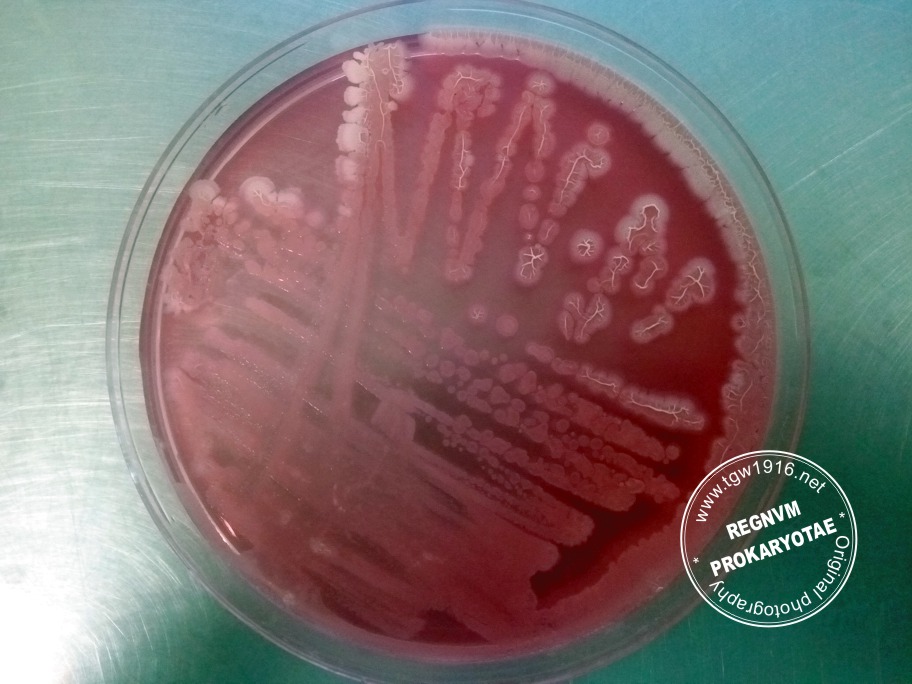
| B. amyloliquefaciens colonies on Chapman agar |
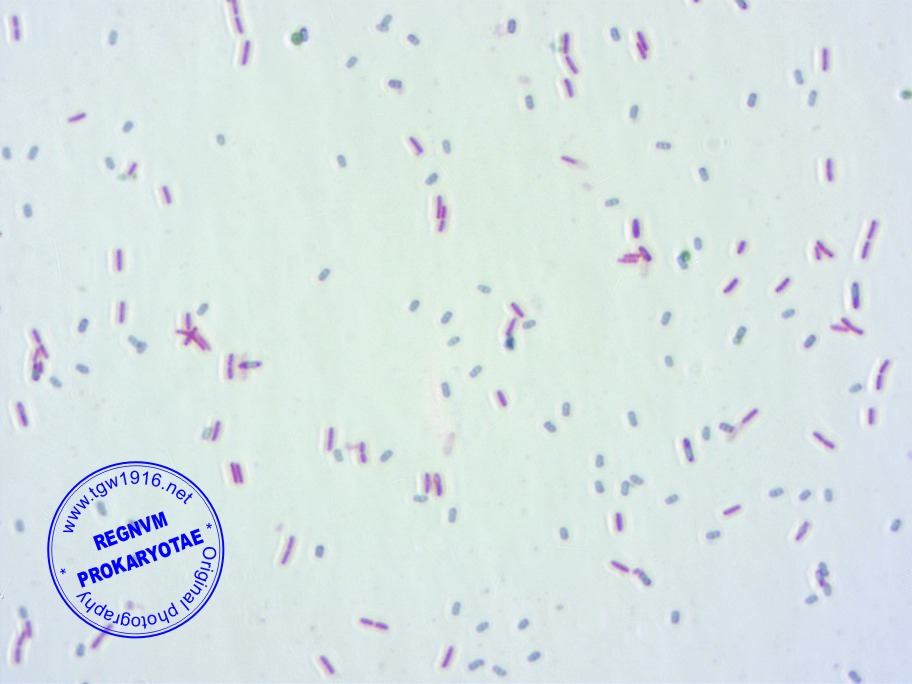
| Spores and vegetative cells. Malachite-green staining. |
Taxonomy
Morphology
Cultural characteristics
Biochemical characters
Ecology
Pathogenicity
References
Phylum Bacillota (Firmicutes), Class Bacilli, Order Caryophanales, Family Bacillaceae, Genus Bacillus, Bacillus amyloliquefaciens
(ex Fukomoto 1943) Priest et al. 1987.
B. amyloliquefaciens subsp. plantarum is a later heterotypic synonym of B. velezensis.
(ex Fukomoto 1943) Priest et al. 1987.
B. amyloliquefaciens subsp. plantarum is a later heterotypic synonym of B. velezensis.
Gram-positive, motile rods, 0.7-0.9 x 1.8-3.0 µm, grouped in chains. Central, para-
central and subterminal, ellipsoidal endospores (0.6-0.8 x 1.0-1.4µm) in unswollen
sporangia.
central and subterminal, ellipsoidal endospores (0.6-0.8 x 1.0-1.4µm) in unswollen
sporangia.
Aerobe, no anaerobic growth. Optimum pH 7, NaCl is not required for growth (NaCl
tolerance is 7-10%). Growth temperature 15-50 ºC, optimum 30-40 ºC. Allntoin or
urate are not required for growth. Haemolytic activity on sheep blood agar. No growth
in the presence of lysozyme (0.001%).
tolerance is 7-10%). Growth temperature 15-50 ºC, optimum 30-40 ºC. Allntoin or
urate are not required for growth. Haemolytic activity on sheep blood agar. No growth
in the presence of lysozyme (0.001%).
Isolated from (+/-desert) soil, brackish sediment and industrial amylase fermentations.
Is an important source of alpha-amylase and protease for industrial applications.
Is an important source of alpha-amylase and protease for industrial applications.
Unknown.
- Priest FG, Goodfellow M, Shute LA, Berkeley RCW. Bacillus amyloliquefaciens sp. nov., nom. rev. Int. J. Syst. Bact. 1987; 37:69-71.
- N.A. Logan and P. De Vos, 2009. Genus I. Bacillus Cohn 1872. In: (Eds.) P.D. Vos, G. Garrity, D. Jones, N.R. Krieg, W. Ludwig, F.A.
Rainey, K.-H. Schleifer, W.B. Whitman. Bergey’s Manual of Systematic Bacteriology, Volume 3: The Firmicutes, Springer, 21-127. - R. Borriss, X.H. Chen, C. Rueckert, J. Blom , A. Becker, B. Baumgarth, B. Fan, R. Pukall, P. Schumann, C. Spröer, H. Junge, J. Vater,
A. Pühler and H.P. Klenk, 2011. Relationship of Bacillus amyloliquefaciens clades associated with strains DSM 7T and FZB42T: a
proposal for Bacillus amyloliquefaciens subsp. amyloliquefaciens subsp. nov. and Bacillus amyloliquefaciens subsp. plantarum
subsp. nov. based on complete genome sequence comparisons. IJSEM 61,1786-1801. - D. Clark, C. Youngblood, M. Taplin, E. Brown, B. S. Williams, C. Phillips, B. Garner, 2014. Impact of Iron Availability on Bacillus
amyloliquefaciens Growth. Advances in Microbiology, 4, 962-967, doi: 10.4236/aim.2014.413107. - L.T. Wang, F.L. Lee, C.J. Tai and H.P. Kuo, 2008. Bacillus velezensis is a later heterotypic synonym of Bacillus amyloliquefaciens.
IJSEM 58,671-675. - Dunlap CA, Kim SJ, Kwon SW, Rooney AP. Bacillus velezensis is not a later heterotypic synonym of Bacillus amyloliquefaciens;
Bacillus methylotrophicus, Bacillus amyloliquefaciens subsp. plantarum and 'Bacillus oryzicola' are later heterotypic synonyms of
Bacillus velezensis based on phylogenomics. Int J Syst Evol Microbiol 2016; 66:1212-1217. - Ruiz-Garcia C, Quesada E, Martinez-Checa F, Llamas I, Urdaci MC, Bejar V. Bacillus axarquiensis sp. nov. and Bacillus malacitensis
sp. nov., isolated from river-mouth sediments in southern Spain. Int J Syst Evol Microbiol 2005; 55:1279-1285.
Positive results for catalase, casein hydrolysis, esculin hydrolysis, gelatin hydrolysis,
nitrate reduction, oxidase, phosphatase, starch hydrolys, Tween 20, 40 and 60
hydrolysis, Voges-Proskauer, acid production from: amygdalin, arbutin, aesculin,
cellobiose, fructose, galactose, D-glucose, glycerol, glycogen, beta-gentibiose,
meso-inositol, inulin, lactose, D-mannitol, maltose, raffinose, ribose, salicin, starch,
sorbitol and sucrose.
Negative results for arginine dihydrolase, celluose degrading, egg yolk reaction, indole
production, lysine decarboxylase, ornithine decarboxylase, phenylalanine deamination,
tryptophan deaminase, tyrosine degradation, urea hydrolysis, acid production from:
adonitol, D-arabitol, D-arabinose, L-arabitol, dulcitol, erythritol, D-fucose, L-fucose,
gluconate, 2- and 5-ketogluconate, lyxose, melezitose, rhamnose, sorbose, xylitol,
L-xylose and methyl beta-xyloside.
Variable results for citrate utilization, beta-galactosidase, H2S production, acid
production from: L-arabinose, galactose, N-acetyl-D-glucosamine, mannose,
melibiose, trehalose and D-xylose.
nitrate reduction, oxidase, phosphatase, starch hydrolys, Tween 20, 40 and 60
hydrolysis, Voges-Proskauer, acid production from: amygdalin, arbutin, aesculin,
cellobiose, fructose, galactose, D-glucose, glycerol, glycogen, beta-gentibiose,
meso-inositol, inulin, lactose, D-mannitol, maltose, raffinose, ribose, salicin, starch,
sorbitol and sucrose.
Negative results for arginine dihydrolase, celluose degrading, egg yolk reaction, indole
production, lysine decarboxylase, ornithine decarboxylase, phenylalanine deamination,
tryptophan deaminase, tyrosine degradation, urea hydrolysis, acid production from:
adonitol, D-arabitol, D-arabinose, L-arabitol, dulcitol, erythritol, D-fucose, L-fucose,
gluconate, 2- and 5-ketogluconate, lyxose, melezitose, rhamnose, sorbose, xylitol,
L-xylose and methyl beta-xyloside.
Variable results for citrate utilization, beta-galactosidase, H2S production, acid
production from: L-arabinose, galactose, N-acetyl-D-glucosamine, mannose,
melibiose, trehalose and D-xylose.

(c) Costin Stoica


| Back |