
| Bacillus cereus |

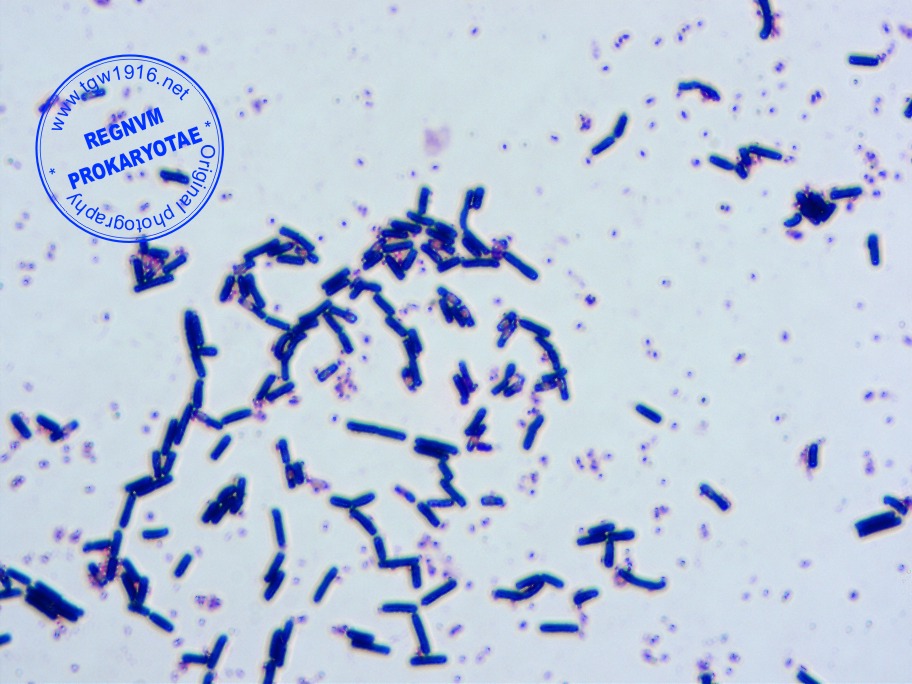
| Bacillus cereus cells and spores |
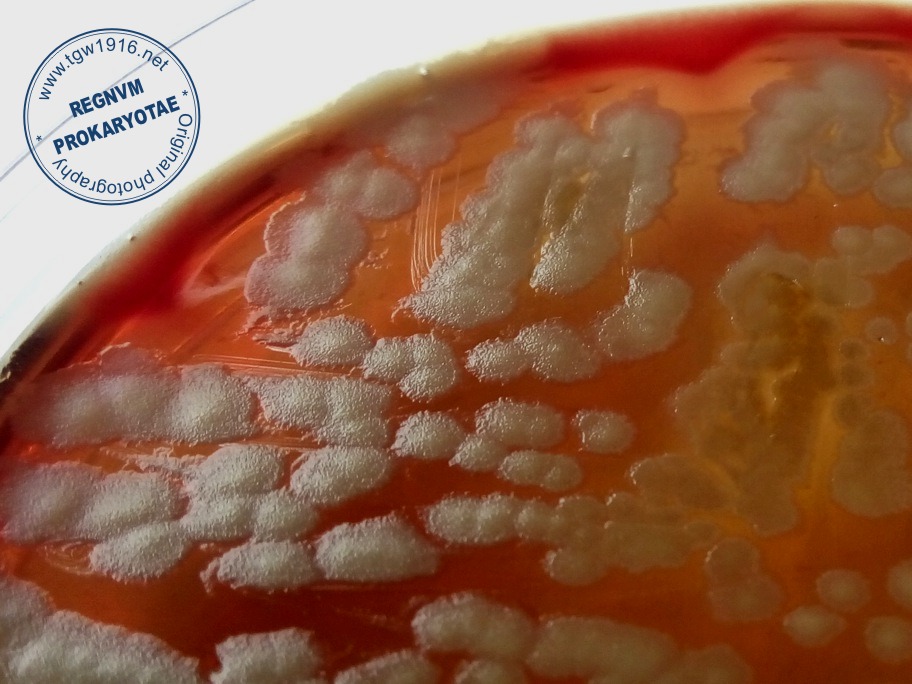
| Bacillus cereus haemolytic, R-type colonies |
Taxonomy
Morphology
Cultural characteristics
Biochemical characters
Ecology
Pathogenicity
References
Phylum Bacillota (Firmicutes), Class Bacilli, Order Caryophanales, Family Bacillaceae, Genus Bacillus, Bacillus cereus Frankland and
Frankland (1887). 42 serovars are recognized on the basis of H-antigens .
Historical synonyms: Bacillus cereus var. fluorescens Laubach (1916) (distinctive property : produces yellow-green fluorescent
pigment), Bacillus cereus var. albolactis (Migula) de Soriano (1935) (acid formed from lactose), Bacillus albolactis Migula (1900).
Phenotypically is very closed to other members of the 'Bacillus cereus' group: Bacillus anthracis, Bacillus mycoides, Bacillus
pseudomycoides, Bacillus thuringiensis and Bacillus weihenstephanensis. Genetic evidence supports the recognition of members of
the Bacillus cereus group as one species, but practical considerations (virulence characters) argue against such a move.
Recent identifications have added more species to the group: B. cytotoxicus, B. toyonensis, B. wiedmannii, B. paranthracis, B. pacificus,
B. tropicus, B. albus, B. mobilis, B. luti, B. proteolyticus, B. nitratireducens, B. paramycoides, B. paramobilis, B. sanguinis and B. hominis
(possible synonym of B. mycoides). ‘B. gaemokensis’, ‘B. manliponensis’ and ‘B. bingmayongensis’ are still waiting for a valid
publication.
Frankland (1887). 42 serovars are recognized on the basis of H-antigens .
Historical synonyms: Bacillus cereus var. fluorescens Laubach (1916) (distinctive property : produces yellow-green fluorescent
pigment), Bacillus cereus var. albolactis (Migula) de Soriano (1935) (acid formed from lactose), Bacillus albolactis Migula (1900).
Phenotypically is very closed to other members of the 'Bacillus cereus' group: Bacillus anthracis, Bacillus mycoides, Bacillus
pseudomycoides, Bacillus thuringiensis and Bacillus weihenstephanensis. Genetic evidence supports the recognition of members of
the Bacillus cereus group as one species, but practical considerations (virulence characters) argue against such a move.
Recent identifications have added more species to the group: B. cytotoxicus, B. toyonensis, B. wiedmannii, B. paranthracis, B. pacificus,
B. tropicus, B. albus, B. mobilis, B. luti, B. proteolyticus, B. nitratireducens, B. paramycoides, B. paramobilis, B. sanguinis and B. hominis
(possible synonym of B. mycoides). ‘B. gaemokensis’, ‘B. manliponensis’ and ‘B. bingmayongensis’ are still waiting for a valid
publication.
Gram-positive, 1.0-1.2 x 3.0-5.0 μm, motile with peritrichous flagella. Ellipsoidal,
central or paracentral spores, rarely distending the sporangia. Sometimes spores
may be cylindrical. Capsule is not present. The bacilli tend to occur in chains.
central or paracentral spores, rarely distending the sporangia. Sometimes spores
may be cylindrical. Capsule is not present. The bacilli tend to occur in chains.
Large, R-type, irregular, opaque colonies, sometimes with a waxy aspect. On agar,
colonies are large, 2-7 mm in diameter; smooth and moist colonies are possible;
usualy are whitish to cream, but some strains may produce a pinkish brown pigment or
a yellow diffusible pigment or a yellowish-green fluorescent pigment. Fresh plate
cultures commonly have a mousy smell. Hemolytic on blood agar.
In liquid media form moderate or intense turbidity, not characteristic.
Facultatively anaerobic. Grow in nutrient broth and in 2- 7% NaCl. Good growth on
nutritive agar; better on nutritive agar with 7-10% sheep blood. Growth at 5,7 pH.
Temperature range 20-40 ºC. Variable growth at 10 and 45 ºC; no growth at 5 ºC
Psychrotolerant strains growing at 60 ºC have been isolated.
NaCl, allantoin or urate are not required for growth.
colonies are large, 2-7 mm in diameter; smooth and moist colonies are possible;
usualy are whitish to cream, but some strains may produce a pinkish brown pigment or
a yellow diffusible pigment or a yellowish-green fluorescent pigment. Fresh plate
cultures commonly have a mousy smell. Hemolytic on blood agar.
In liquid media form moderate or intense turbidity, not characteristic.
Facultatively anaerobic. Grow in nutrient broth and in 2- 7% NaCl. Good growth on
nutritive agar; better on nutritive agar with 7-10% sheep blood. Growth at 5,7 pH.
Temperature range 20-40 ºC. Variable growth at 10 and 45 ºC; no growth at 5 ºC
Psychrotolerant strains growing at 60 ºC have been isolated.
NaCl, allantoin or urate are not required for growth.
Resistant to lysozyme. Spores are widespread (soil, water, air, foods etc).
Synthesize heat-stabile emetic toxin, cytotoxin, hemolysin, mice lethal toxin, enterotoxin, bacteria lytic enzymes, proteolytic enzymes
and phospholipase C.
B. cereus is a pathogen of humans (and other animals), causing foodborne illness (diarrheal-type and emetic-type syndromes) and
opportunistic infections (endophtalmia, keratitis, septicemia, meningitis, endocarditis, pneumonia, osteomielitis, urinary infections,
cutaneous infections. It also causes infections in domestic animals (mastitis and abortion in cattle).
and phospholipase C.
B. cereus is a pathogen of humans (and other animals), causing foodborne illness (diarrheal-type and emetic-type syndromes) and
opportunistic infections (endophtalmia, keratitis, septicemia, meningitis, endocarditis, pneumonia, osteomielitis, urinary infections,
cutaneous infections. It also causes infections in domestic animals (mastitis and abortion in cattle).
- Gordon R.E., Haynes W.C., Pang C.H. (1973) – The genus Bacillus . Agriculture Handbook No. 427, U.S.D.A., Washington D.C.
- Buchanan R.E., Gibbons N.E., Cowan S.T., Holt J.G., Liston J., Murray R.G.E., Niven C.F., Ravin A.W., Stanier R.W. ( 1974) –
Bergey’s Manual of Determinative Bacteriology, Eight Edition, The Williams & Wilkins Company, Baltimore. - Bîlbîie V., Pozsgi N., 1985, Bacteriologie Medicala, vol.ll, Ed. Medicala, Bucuresti.
- H. Răducănescu, Valeria Bica-Popii, 1986. Bacteriologie veterinară, Ed. Ceres, Bucureşti.
- Buiuc D., Negut M. , 2009. Tratat de Microbiologie Clinica, editia a III-a, Editura Medicala, Bucuresti.
- Logan N. A.,2005. Bacillus anthracis, Bacillus cereus, and other aerobic endospore-forming bacteria. In: Boriello S.P., Murray P.R.,
Funke G. (Ed),Topley & Wilson’s Microbiology & Microbial Infections.Bacteriology, Vol. 2, pp. 922-952. - N.A. Logan and P. De Vos, 2009. Genus I. Bacillus Cohn 1872. In: (Eds.) P.D. Vos, G. Garrity, D. Jones, N.R. Krieg, W. Ludwig, F.A.
Rainey, K.-H. Schleifer, W.B. Whitman. Bergey’s Manual of Systematic Bacteriology, Volume 3: The Firmicutes, Springer, 21-127. - Liu Y, Du J, Lai Q, Zeng R, Ye D, Xu J, Shao Z. Proposal of nine novel species of the Bacillus cereus group. Int J Syst Evol Microbiol
2017; 67:2499-2508. - Miller RA, Beno SM, Kent DJ, Carroll LM, Martin NH, Boor KJ, Kovac J. Bacillus wiedmannii sp. nov., a psychrotolerant and cytotoxic
Bacillus cereus group species isolated from dairy foods and dairy environments. Int J Syst Evol Microbiol 2016; 66:4744-4753. - Tohya M, Hishinuma T, Watanabe S, Shimojima M, Ogawa M, Tada T, Kirikae T. Three novel species of the Bacillus cereus group
isolated from clinical samples in Japan. Int J Syst Evol Microbiol 2021; 71:4993.
Positive results for caseinase, catalase, esculin hydrolysis, gelatinase, egg yolk
reaction, nitrate reduction to nitrite (most strains), starch hydrolysis (negative for the
emetic biotype), decomposition of tyrosine, Voges-Proskauer test, formation of alkali
in litmus milk, acid production from: N-acetyl-D-glucosamine, arbutin, fructose,
glucose, glycogen (negative for emetic biotype), glycerol (variable for the emetic
biotype), maltose, ribose and trehalose.
Negative results for beta-galactosidase, H2S production, indole production, lysine
decarboxylase, ornithine decarboxylase, oxidase, deamination of phenylalanine, gas
production from carbohydrates, acid production from: arabinose, adonitol, amygdalin,
D- or L-arabitol, dulcitol, erythritol, D- or L-fucose, galactose, meso-inositol, inulin,
2-ketogluconate, 5-ketogluconate, lactose, lyxose, melezitose, melibiose, mannitol,
D-mannose, alpha-metyl- D-mannoside, methyl beta-xyloside, raffinose, rhamnose,
sorbitol, sorbose, xylose and xylitol.
Variable results for citrate utilization, hydrolysis of urea, digestion of litmus milk,
arginine dihydrolase, acid production from: cellobiose, beta-gentibiose, gluconate,
salicin, starch and sucrose.
reaction, nitrate reduction to nitrite (most strains), starch hydrolysis (negative for the
emetic biotype), decomposition of tyrosine, Voges-Proskauer test, formation of alkali
in litmus milk, acid production from: N-acetyl-D-glucosamine, arbutin, fructose,
glucose, glycogen (negative for emetic biotype), glycerol (variable for the emetic
biotype), maltose, ribose and trehalose.
Negative results for beta-galactosidase, H2S production, indole production, lysine
decarboxylase, ornithine decarboxylase, oxidase, deamination of phenylalanine, gas
production from carbohydrates, acid production from: arabinose, adonitol, amygdalin,
D- or L-arabitol, dulcitol, erythritol, D- or L-fucose, galactose, meso-inositol, inulin,
2-ketogluconate, 5-ketogluconate, lactose, lyxose, melezitose, melibiose, mannitol,
D-mannose, alpha-metyl- D-mannoside, methyl beta-xyloside, raffinose, rhamnose,
sorbitol, sorbose, xylose and xylitol.
Variable results for citrate utilization, hydrolysis of urea, digestion of litmus milk,
arginine dihydrolase, acid production from: cellobiose, beta-gentibiose, gluconate,
salicin, starch and sucrose.

(c) Costin Stoica

| Back |