
| Bacillus mycoides |
Taxonomy
Morphology
Growth conditions
Biochemical characters
Ecology
Pathogenicity
References
Phylum Bacillota (Firmicutes), Class Bacilli, Order Caryophanales, Family Bacillaceae, Genus Bacillus, Bacillus mycoides Flugge
(1886).
Synonyms: Bacillus cereus var. mycoides Smith, Gordon and Clarck (1946), Bacillus weihenstephanensis Lechner et al. 1998,
Bacillus hominis Tohya et al. 2021.
Phenotypically is very closed to other members of the Bacillus cereus group: Bacillus anthracis, Bacillus cereus, Bacillus
pseudomycoides, Bacillus thuringiensis and Bacillus weihenstephanensis.
Genetic evidence supports the recognition of members of the Bacillus cereus group as
one species, but practical considerations (virulence characters) argue against such a
move. Bacillus mycoides is distinguished by its characteristic rhizoid colonies and
absence of motility. Bacillus pseudomycoides can only be separated from Bacillus
mycoides by DNA relatedness and some differences in fatty acid composition.
(1886).
Synonyms: Bacillus cereus var. mycoides Smith, Gordon and Clarck (1946), Bacillus weihenstephanensis Lechner et al. 1998,
Bacillus hominis Tohya et al. 2021.
Phenotypically is very closed to other members of the Bacillus cereus group: Bacillus anthracis, Bacillus cereus, Bacillus
pseudomycoides, Bacillus thuringiensis and Bacillus weihenstephanensis.
Genetic evidence supports the recognition of members of the Bacillus cereus group as
one species, but practical considerations (virulence characters) argue against such a
move. Bacillus mycoides is distinguished by its characteristic rhizoid colonies and
absence of motility. Bacillus pseudomycoides can only be separated from Bacillus
mycoides by DNA relatedness and some differences in fatty acid composition.
Gram-positive rods, non-motile, 1.0-1.2 x 3.0-5.0 µm. Cells grown on glucose agar
produce large amounts of storage material, giving a vacuolate or foamy appearance.
Spores are ellipsoidal, central, paracentral or subterminal, not distending the
sporangia. Capsule is not present. The bacilli tend to occur in chains.
produce large amounts of storage material, giving a vacuolate or foamy appearance.
Spores are ellipsoidal, central, paracentral or subterminal, not distending the
sporangia. Capsule is not present. The bacilli tend to occur in chains.
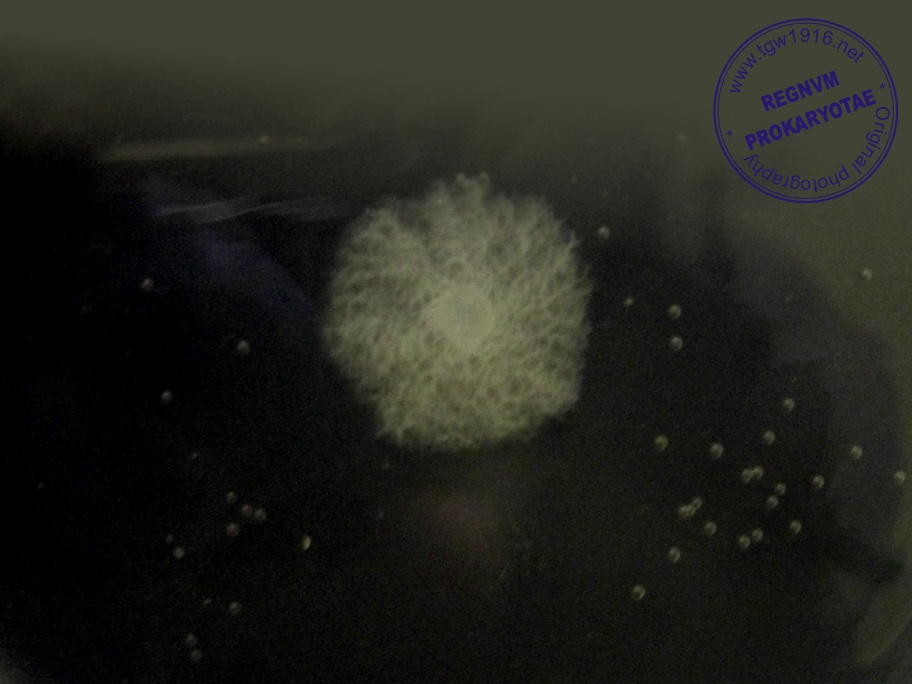
Colonies are white to cream, opaque, and characteristically rhizoid; this ability to form rhizoid colonies may be lost. Maximum
temperature, 35-40 ºC; minimum temperature, 8-15 ºC. Grow in anaerobic agar and in nutrient broth. Growth in 7% NaCl is variable.
Grow at pH 5.7 (also at pH 6 and 7). Facultatively anaerobic.
B. hominis colonies are not rhizoid, are circular, white and usually 3-5mm in diameter after growth for 2days at 30 ºC.
temperature, 35-40 ºC; minimum temperature, 8-15 ºC. Grow in anaerobic agar and in nutrient broth. Growth in 7% NaCl is variable.
Grow at pH 5.7 (also at pH 6 and 7). Facultatively anaerobic.
B. hominis colonies are not rhizoid, are circular, white and usually 3-5mm in diameter after growth for 2days at 30 ºC.
Spores are widespread (soil, water, air, foods etc). Can grow in the presence of lysozyme.
The former Bacillus hominis strain was isolated from a blood sample of a patient in Japan.
The former Bacillus hominis strain was isolated from a blood sample of a patient in Japan.
Tardive hemolysis, non-pathogenic for mouse.
- Gordon R.E., Haynes W.C., Pang C.H. (1973) – The genus Bacillus . Agriculture Handbook No. 427, U.S.D.A., Washington D.C.
- Buchanan R.E., Gibbons N.E., Cowan S.T., Holt J.G., Liston J., Murray R.G.E., Niven C.F., Ravin A.W., Stanier R.W. ( 1974) –
Bergey’s Manual of Determinative Bacteriology, Eight Edition, The Williams & Wilkins Company, Baltimore. - Bîlbîie V., Pozsgi N., 1985, Bacteriologie Medicală, vol.ll, Ed. Medicală, Bucureşti.
- Logan N. A.,2005. Bacillus anthracis, Bacillus cereus, and other aerobic endospore-forming bacteria. In: Boriello S.P., Murray P.R.,
Funke G. (Ed),Topley & Wilson’s Microbiology & Microbial Infections.Bacteriology, Vol. 2, pp. 922-952. - N.A. Logan and P. De Vos, 2009. Genus I. Bacillus Cohn 1872. In: (Eds.) P.D. Vos, G. Garrity, D. Jones, N.R. Krieg, W. Ludwig, F.A.
Rainey, K.-H. Schleifer, W.B. Whitman. Bergey’s Manual of Systematic Bacteriology, Volume 3: The Firmicutes, Springer, 21-127. - Liu Y, Lai Q, Shao Z. Genome analysis-based reclassification of Bacillus weihenstephanensis as a later heterotypic synonym of
Bacillus mycoides. Int J Syst Evol Microbiol 2018; 68:106-112. - Tohya M, Hishinuma T, Watanabe S, Shimojima M, Ogawa M, Tada T, Kirikae T. Three novel species of the Bacillus cereus group
isolated from clinical samples in Japan. Int J Syst Evol Microbiol 2021; 71:4993. - Goker, M., Christensen, H., Fingerle, V., Kostovski, M,, Margos, G., Moore, E.R.B., Oren, A., Patrick, S., Reischl, U., Vazquez-Boland,
J.A. (2025). List of Recommended Names for bacteria of medical importance: report of the Ad Hoc Committee on Mitigating
Changes in Prokaryotic Nomenclature. Int J Syst Evol Microbiol, 75:6943; DOI: 10.1099/ijsem.0.006943
Positive results for acid and alkaline phosphatase, catalase, casein hydrolysis,
esculin hydrolysis, reduction of nitrate to nitrite, starch hydrolysis, Voges-Proskauer,
gelatin hydrolysis, egg yolk reaction, formation of alkali in litmus milk, acid production
from: N-acetyl-D-glucosamine, glucose, glycogen (B. hominis strain is negative),
glycerol, starch and trehalose.
Negative results for alpha- and beta-galactosidase, gas production from
carbohydrates, H2S production, indole production, oxidase, deamination of
phenylalanine, valine arylamidase (B. hominis strain is positive), acid production from
arabinose, adonitol, D- or L-arabitol, dulcitol, erythritol, D- or L-fucose,
beta-gentibiose, gluconate, meso-inositol, inulin, 2- or 5-ketogluconate, lactose,
lyxose, maltose, mannitol, D-mannose, alpha-metyl-D- mannoside, melezitose,
melibiose, raffinose, rhamnose, sorbitol, sorbose, xylose, methyl beta-xyloside, xylitol
D- or L-xylose.
Variable results for urease, nitrate reduction, decomposition of tyrosine, use of citrate,
alkaline digestion of litmus milk, beta-galactosidase, lysine decarboxylase, ornithine
decarboxylase, arginine dihydrolase, acid production from amygdalin, arbutin,
cellobiose, fructose, galactose, ribose, salicin and sucrose.
esculin hydrolysis, reduction of nitrate to nitrite, starch hydrolysis, Voges-Proskauer,
gelatin hydrolysis, egg yolk reaction, formation of alkali in litmus milk, acid production
from: N-acetyl-D-glucosamine, glucose, glycogen (B. hominis strain is negative),
glycerol, starch and trehalose.
Negative results for alpha- and beta-galactosidase, gas production from
carbohydrates, H2S production, indole production, oxidase, deamination of
phenylalanine, valine arylamidase (B. hominis strain is positive), acid production from
arabinose, adonitol, D- or L-arabitol, dulcitol, erythritol, D- or L-fucose,
beta-gentibiose, gluconate, meso-inositol, inulin, 2- or 5-ketogluconate, lactose,
lyxose, maltose, mannitol, D-mannose, alpha-metyl-D- mannoside, melezitose,
melibiose, raffinose, rhamnose, sorbitol, sorbose, xylose, methyl beta-xyloside, xylitol
D- or L-xylose.
Variable results for urease, nitrate reduction, decomposition of tyrosine, use of citrate,
alkaline digestion of litmus milk, beta-galactosidase, lysine decarboxylase, ornithine
decarboxylase, arginine dihydrolase, acid production from amygdalin, arbutin,
cellobiose, fructose, galactose, ribose, salicin and sucrose.

(c) Costin Stoica
| Bacillus mycoides rhizoid colony |


| Back |