
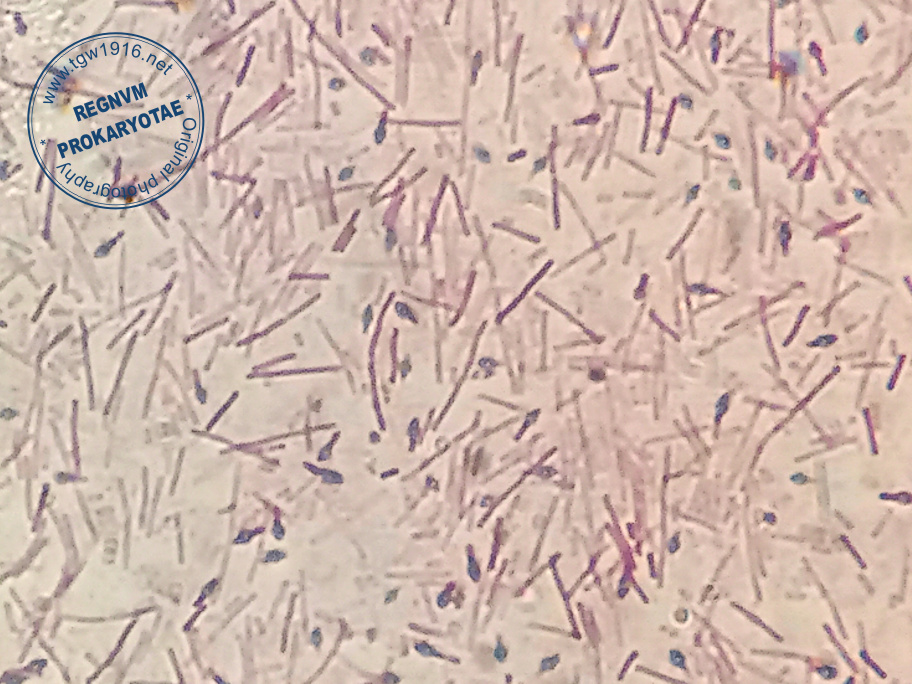
| L. sphaericus sub-terminal spores, swelling the vegetative cells - Malachite-green staining |
| Lysinibacillus sphaericus |
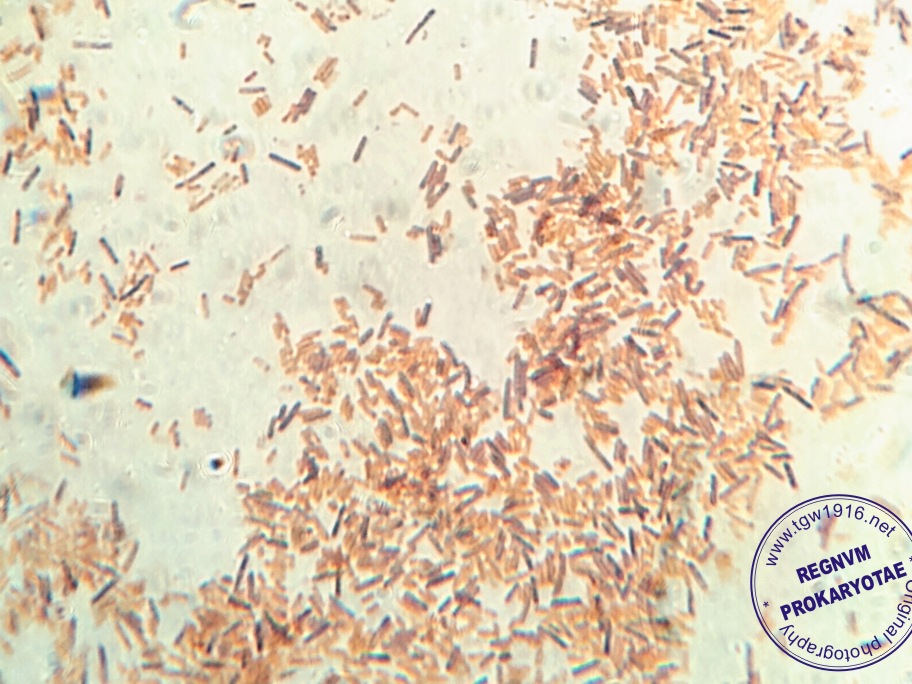
| Lysinibacillus sphaericus - Gram stained cells |
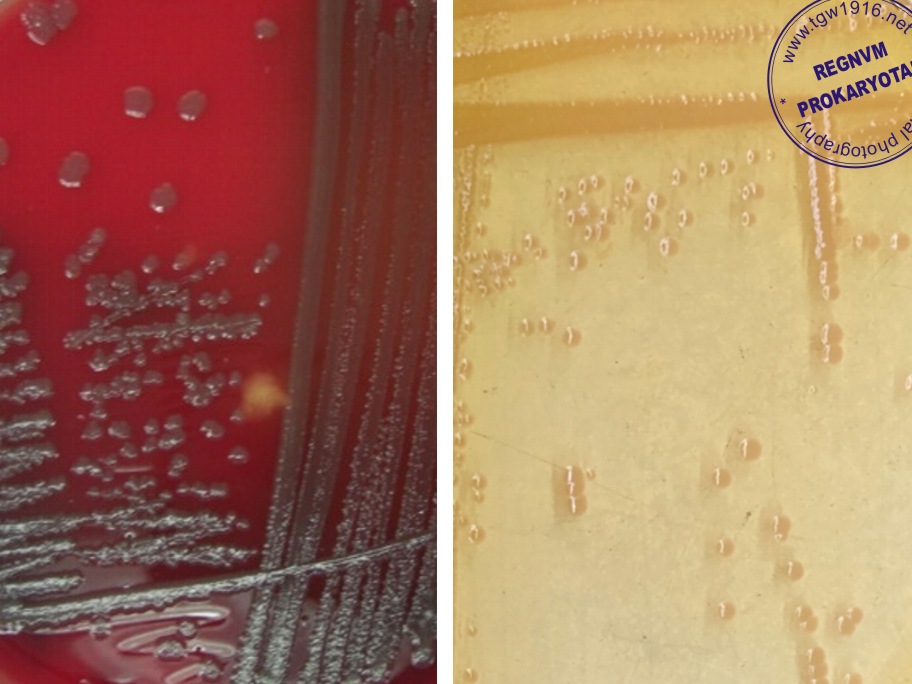
| Lysinibacillus sphaericus colonies on Sheep Blood Agar (left) and BHI Agar (right) |
Taxonomy
Morphology
Cultural characterisics
Biochemical characters
Ecology
Pathogenicity
References
Phylum Bacillota (Firmicutes), Class Bacilli, Order Caryophanales, Family Caryophanaceae, Genus Lysinibacillus, Lysinibacillus
sphaericus (Meyer and Neide 1904) Ahmed, Yokota,Yamazoe and Fujiwara 2007.
Historical synonyms: Bacillus sphaericus Neide (1904), B. lactimorbi Jordan and Harris (1908), B. loehnisii Gibson (1935b), B.
rotans Roberts (1935), B. sphaericus var. rotans Smith, Gordon and Clarck (1946), B. serositidis Lacorte (1932).
sphaericus (Meyer and Neide 1904) Ahmed, Yokota,Yamazoe and Fujiwara 2007.
Historical synonyms: Bacillus sphaericus Neide (1904), B. lactimorbi Jordan and Harris (1908), B. loehnisii Gibson (1935b), B.
rotans Roberts (1935), B. sphaericus var. rotans Smith, Gordon and Clarck (1946), B. serositidis Lacorte (1932).
Gram-positive or Gram-variable, 1.5-5.0 x 0.6-1.0 µm, motile by fairly abundant peritrichous flagella or only polar flagella that
coalesced in a long ribbon.
Spores are spherical, subterminal or terminal, swelling the sporangia.
coalesced in a long ribbon.
Spores are spherical, subterminal or terminal, swelling the sporangia.
Colonies are opaque, unpigmented, smooth, often glossy. Growth on nutrient agar
varies in different strains from compact and heaped to a wide spreading over the
surface; uncommon strains produce pink colonies. Maximum temperature 30-45 ºC;
minimum temperature 5-15 ºC. Grow at ph 5.7-9.5. Growth at 5.7-6 pH is a variable
property. Aerobic. Grow in 0-5% NaCl. Nonhemolytic.
Biotin and thiamin are required for growth; allantoin or urate are not required.
varies in different strains from compact and heaped to a wide spreading over the
surface; uncommon strains produce pink colonies. Maximum temperature 30-45 ºC;
minimum temperature 5-15 ºC. Grow at ph 5.7-9.5. Growth at 5.7-6 pH is a variable
property. Aerobic. Grow in 0-5% NaCl. Nonhemolytic.
Biotin and thiamin are required for growth; allantoin or urate are not required.
Isolated from food, water, clinical specimens and mosquitoes. Spores occur in soil.
Resistant to chloramphenicol (8 µg/ml), erythromicyn (1 µg/ml), streptomycin (8 µg/ml),
tetracycline (2 µg/ml) and rifampicin (0.25 µg/ml).
Resistant to chloramphenicol (8 µg/ml), erythromicyn (1 µg/ml), streptomycin (8 µg/ml),
tetracycline (2 µg/ml) and rifampicin (0.25 µg/ml).
Is an accidental human pathogen; may be involved in bacteremia, meningitis,
pseudotumors, food infections. Some strains may be highly toxic to some species of
mosquito larvae, such as Culex sp., Anopheles sp., and Psorophora sp., but seems to
show low toxicity against Aedes sp. larvae.
pseudotumors, food infections. Some strains may be highly toxic to some species of
mosquito larvae, such as Culex sp., Anopheles sp., and Psorophora sp., but seems to
show low toxicity against Aedes sp. larvae.
- Gordon R.E., Haynes W.C., Pang C.H. (1973) – The genus Bacillus . Agriculture
Handbook No. 427, U.S.D.A., Washington D.C. - Buchanan R.E., Gibbons N.E., Cowan S.T., Holt J.G., Liston J., Murray R.G.E.,
Niven C.F., Ravin A.W., Stanier R.W. ( 1974) – Bergey’s Manual of Determinative
Bacteriology, Eight Edition, The Williams & Wilkins Company, Baltimore. - Buiuc D., Negut M. , 1999. Tratat de Microbiologie Clinica, Editura Medicala,
Bucuresti. - N.A. Logan and P. De Vos, 2009. Genus I. Bacillus Cohn 1872. In: (Eds.) P.D. Vos,
G. Garrity, D. Jones, N.R. Krieg, W. Ludwig, F.A. Rainey, K.-H. Schleifer, W.B.
Whitman. Bergey’s Manual of Systematic Bacteriology, Volume 3: The Firmicutes,
Springer, 21-127. - Ahmed I.,Yokota A, Yamazoe A.,and Fujiwara T., 2007. Proposal of Lysinibacillus
boronitolerans gen. nov. sp. nov., and transfer of Bacillus fusiformis to
Lysinibacillus fusiformis comb. nov. and Bacillus sphaericus to Lysinibacillus
sphaericus comb. nov. IJSEM 57, 1117-1126. - P. Isaacson, P. H. Jacobs, A. M. R. Mackenzie, and A. W. Mathews. Pseudotumour
of the lung caused by infection with Bacillus sphaericus. J. Clin. Path., 1976, 29,
806-811. - Lacey LA. Bacillus thuringiensis serovariety israelensis and Bacillus sphaericus
for mosquito control. J Am Mosq Control Assoc. 2007;23(Suppl 2):133–163
Positive results for catalase, hydrolysis of casein, deamination of phenylalanine,
oxidase, and hydrolysis of Tween 20.
Negative results for arginine dihydrolase, degradation of tyrosine, beta-galactosidase,
lysine decarboxylase, ornithine decarboxylase, hydrolysis of esculin, hydrolysis of
hippurate, egg yolk reaction, indole production, H2S production, acid production from
D-mannose, methyl beta-xyloside, glycerol, glycogen, salicin, starch, adonitol,
amygdalin, D- or L-arabitol, arbutin, cellobiose, dulcitol, erythritol, fructose, D- or
L-fucose, galactose, beta-gentibiose, gluconate, meso-inositol, inulin, 2- or
5-ketogluconate, lactose, lyxose, maltose, melezitose, melibiose, raffinose,
rhamnose, ribose, sorbitol, sorbose, sucrose, trehalose, xylitol, D- and L-xylose.
Variable results for citrate utilization, gelatinase, urease, hydrolysis of Tween 80 and
acid production from N-acetyl-D-glucosamine.
oxidase, and hydrolysis of Tween 20.
Negative results for arginine dihydrolase, degradation of tyrosine, beta-galactosidase,
lysine decarboxylase, ornithine decarboxylase, hydrolysis of esculin, hydrolysis of
hippurate, egg yolk reaction, indole production, H2S production, acid production from
D-mannose, methyl beta-xyloside, glycerol, glycogen, salicin, starch, adonitol,
amygdalin, D- or L-arabitol, arbutin, cellobiose, dulcitol, erythritol, fructose, D- or
L-fucose, galactose, beta-gentibiose, gluconate, meso-inositol, inulin, 2- or
5-ketogluconate, lactose, lyxose, maltose, melezitose, melibiose, raffinose,
rhamnose, ribose, sorbitol, sorbose, sucrose, trehalose, xylitol, D- and L-xylose.
Variable results for citrate utilization, gelatinase, urease, hydrolysis of Tween 80 and
acid production from N-acetyl-D-glucosamine.

(c) Costin Stoica


| Back |