
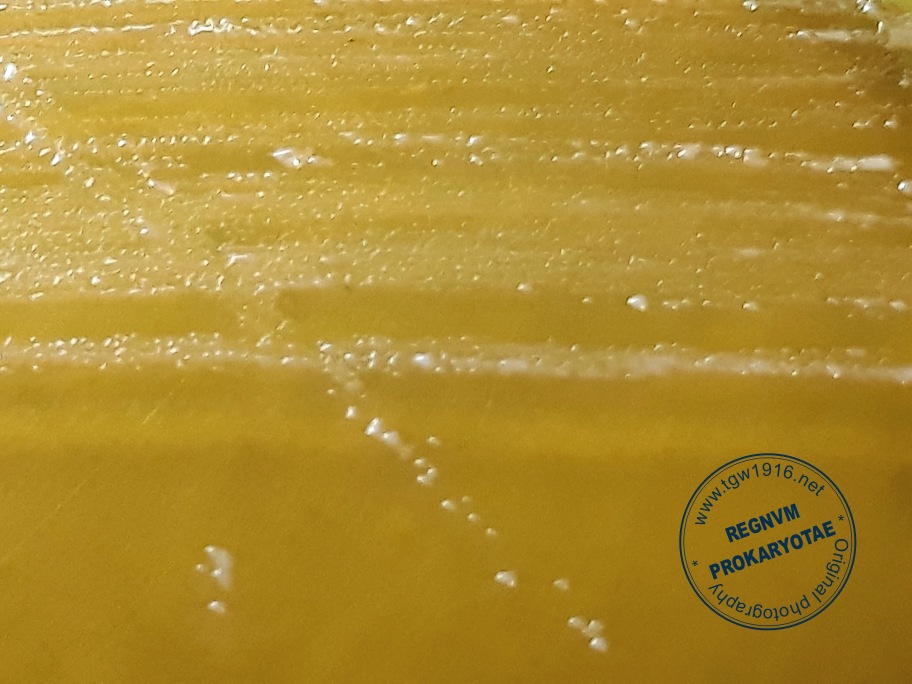
| L. reuteri subsp. reuteri colonies on MRS agar |
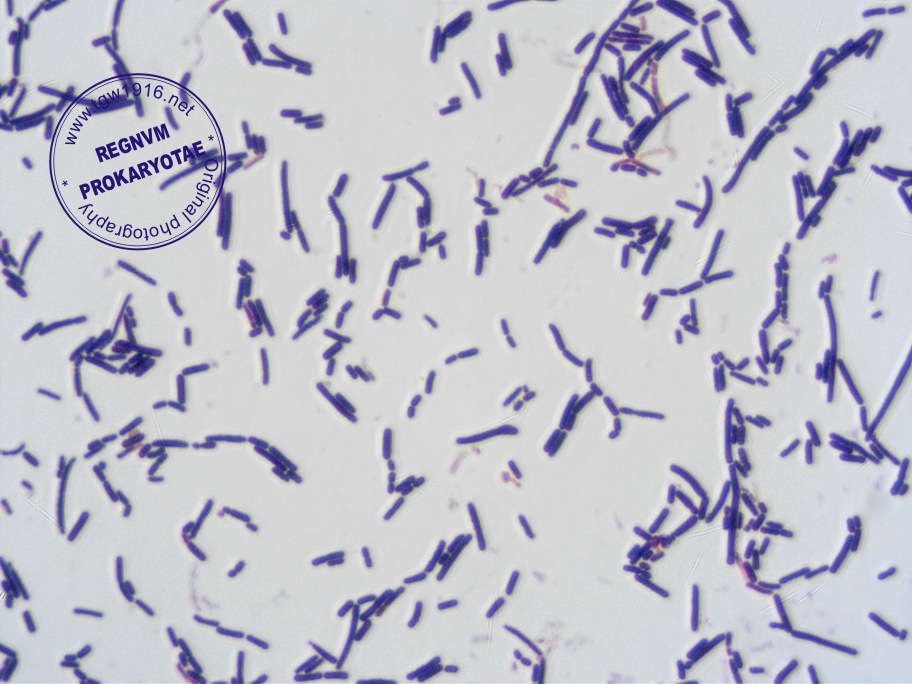
| L. reuteri subsp. reuteri Gram-stained cells |
| Lactobacillus (Limosilactobacillus) reuteri |
Taxonomy
Morphology
Cultural characteristics
Biochemical characters
Ecology
Pathogenicity
References
Phylum Bacillota (Firmicutes), Class Bacilli, Order Lactobacillales, Family Lactobacillaceae, Genus Lactobacillus [Group C lactobacilli
(obligately heterofermentative), Lactobacillus reuteri - phylogenetic group], Lactobacillus reuteri Kandler, Stetter and Kohl 1982.
Moved to Phylum Firmicutes, Class Bacilli, Order Lactobacillales, Family Lactobacillaceae, Genus Limosilactobacillus Zheng et al.
2020.
Old synonym: Lactobacillus fermentum type II Lerche and Reuter 1962.
6 subspecies according to Li et al. 2021:
- Limosilactobacillus reuteri subsp. kinnaridis Li et al. 2021;
- Limosilactobacillus reuteri subsp. murium Li et al. 2021;
- Limosilactobacillus reuteri subsp. porcinus Li et al. 2021;
- Limosilactobacillus reuteri subsp. reuteri (Kandler et al. 1982) Li et al. 2021;
- Limosilactobacillus reuteri subsp. rodentium Li et al. 2021;
- Limosilactobacillus reuteri subsp. suis Li et al. 2021.
(obligately heterofermentative), Lactobacillus reuteri - phylogenetic group], Lactobacillus reuteri Kandler, Stetter and Kohl 1982.
Moved to Phylum Firmicutes, Class Bacilli, Order Lactobacillales, Family Lactobacillaceae, Genus Limosilactobacillus Zheng et al.
2020.
Old synonym: Lactobacillus fermentum type II Lerche and Reuter 1962.
6 subspecies according to Li et al. 2021:
- Limosilactobacillus reuteri subsp. kinnaridis Li et al. 2021;
- Limosilactobacillus reuteri subsp. murium Li et al. 2021;
- Limosilactobacillus reuteri subsp. porcinus Li et al. 2021;
- Limosilactobacillus reuteri subsp. reuteri (Kandler et al. 1982) Li et al. 2021;
- Limosilactobacillus reuteri subsp. rodentium Li et al. 2021;
- Limosilactobacillus reuteri subsp. suis Li et al. 2021.
Gram-positive, slightly irregular, bent rods with rounded ends, 0.7-1.0 x 2.0-5.0 µm,
occuring singly, in pairs and in small clusters. Nonmotile.
occuring singly, in pairs and in small clusters. Nonmotile.
Can grow at 45 ºC, not at 15 ºC.
Subsp. reuteri was isolated from the gastrointestinal tract of humans and herbivores. Probiotic strains were isolated from human
breast milk, oral cavity. Produce the antimicrobial compound reuterin. It have been considered immunosuppressive, suppressing
proinflammatory cytokines TNF, IL-1β, IL-12 and MCP-1 (monocyte chemoattractant protein); suppress intestinal inflamation.
Subsp. kinnaridis was isolated from the gastrointestinal tract of poultry (chicken, pheasant) and humans. It elevate fitness in chickens
but not in humans, suggesting that this is autochthonous of chicken and share an evolutionary history with poultry. Produce the
antimicrobial compound reuterin. They are immunostimmulatory; stimulate the production of IL-7, IL-12 and IL-13 but suppress IL-5.
Synthesize folate.
Subsp. porcinus was isolated from the gastrointestinal tract of pigs. Produces the antimicrobial compound reuterin.
Subsp. murium was isolated from the gastrointestinal tract of rodents; that strains are rodent-specific, displayed elevated fitness in
mice through the colonization and biofilm formation on the forestomach epithelium, so their evolution with rodents was adaptive and
led to host specificity. Rarely produce the antimicrobial compound reuterin. Produce urease for acid resistance.
Subsp. suis was isolated from the gastrointestinal tract of pigs; that strain are pig-specific. Their mucus-binding protein (Mub), that
bind mucus and/or IgA, specifically supports the colonization of this subspecies to the porcine gastrointestinal tract. Have been
applied as probiotics to improve porcine intestinal health, prevent diarrhoea and immune modulation.
Subsp. rodentium was isolated from the gastrointestinal tract of rat; that strains are rodent-specific, displayed elevated fitness in mice
through the colonization and biofilm formation on the forestomach epithelium, so their evolution with rodents was adaptive and led to
host specificity. Rarely produce the antimicrobial compound reuterin. Produce urease for acid resistance. Other strains are isolated
from sourdough, and produce reutericycline, a unique antimicrobial tetramic acid with activity against Gram-positive bacteria.
breast milk, oral cavity. Produce the antimicrobial compound reuterin. It have been considered immunosuppressive, suppressing
proinflammatory cytokines TNF, IL-1β, IL-12 and MCP-1 (monocyte chemoattractant protein); suppress intestinal inflamation.
Subsp. kinnaridis was isolated from the gastrointestinal tract of poultry (chicken, pheasant) and humans. It elevate fitness in chickens
but not in humans, suggesting that this is autochthonous of chicken and share an evolutionary history with poultry. Produce the
antimicrobial compound reuterin. They are immunostimmulatory; stimulate the production of IL-7, IL-12 and IL-13 but suppress IL-5.
Synthesize folate.
Subsp. porcinus was isolated from the gastrointestinal tract of pigs. Produces the antimicrobial compound reuterin.
Subsp. murium was isolated from the gastrointestinal tract of rodents; that strains are rodent-specific, displayed elevated fitness in
mice through the colonization and biofilm formation on the forestomach epithelium, so their evolution with rodents was adaptive and
led to host specificity. Rarely produce the antimicrobial compound reuterin. Produce urease for acid resistance.
Subsp. suis was isolated from the gastrointestinal tract of pigs; that strain are pig-specific. Their mucus-binding protein (Mub), that
bind mucus and/or IgA, specifically supports the colonization of this subspecies to the porcine gastrointestinal tract. Have been
applied as probiotics to improve porcine intestinal health, prevent diarrhoea and immune modulation.
Subsp. rodentium was isolated from the gastrointestinal tract of rat; that strains are rodent-specific, displayed elevated fitness in mice
through the colonization and biofilm formation on the forestomach epithelium, so their evolution with rodents was adaptive and led to
host specificity. Rarely produce the antimicrobial compound reuterin. Produce urease for acid resistance. Other strains are isolated
from sourdough, and produce reutericycline, a unique antimicrobial tetramic acid with activity against Gram-positive bacteria.
Undetermined (none). Used in probiotic products for newborns and adults.
- Hammes W.P. and Hertel C., 2009. Genus I. Lactobacillus Beijerinck 1901. In: (Eds.) P.D. Vos, G. Garrity, D. Jones, N.R. Krieg, W.
Ludwig, F.A. Rainey, K.-H. Schleifer, W.B. Whitman. Bergey’s Manual of Systematic Bacteriology, Volume 3: The Firmicutes,
Springer, 465-511. - Li F, Cheng CC, Zheng J, Liu J, Quevedo RM, Li J, Roos S, Gänzle MC and Walter J, 2021. Limosilactobacillus balticus sp. nov.,
Limosilactobacillus agrestis sp. nov., Limosilactobacillus albertensis sp. nov., Limosilactobacillus rudii sp. nov. and
Limosilactobacillus fastidiosus sp. nov., five novel Limosilactobacillus species isolated from the vertebrate gastrointestinal tract,
and proposal of six subspecies of Limosilactobacillus reuteri adapted to the gastrointestinal tract of specific vertebrate hosts. Int J
Syst Microbiol. 71, DOI 10.1099/ijsem.0.004644. - Zheng J, Wittouck S, Salvetti E, Franz MAP et al., 2020. A taxonomic note on the genus Lactobacillus: Description of 23 novel
genera, emended description of the genus Lactobacillus Beijerinck 1901, and union of Lactobacillaceae and Leuconostocaceae.
Int J Syst Microbiol. 70, 2782-2858.
Obligately heterofermentative (hexoses are fermented to lactic and acetic acid
(ethanol), and CO2 via the phosphogluconate pathway; pentoses are fermented to
lactic acid and acetic acid by the related pentose phosphate pathaway).
(ethanol), and CO2 via the phosphogluconate pathway; pentoses are fermented to
lactic acid and acetic acid by the related pentose phosphate pathaway).
(c) Costin Stoica

Positive results for fermentation of: galactose, glucose (without gas production),
lactose, maltose, melibiose, raffinose, ribose and sucrose.
Negative results for fermentation of: adonitol, amygdalin, arbutin, D-arabinose, D- and
L-arabitol, cellobiose, dulcitol, erythritol, esculin, L- and D-fucose, D-fructose,
gentiobiose, 2- and 5-ketogluconate, glycerol, glycogen, inositol, inulin, D-lyxose,
mannitol, mannose, melezitose, methyl alpha-D-mannopyranoside, methyl
alpha-D-xyloside, rhamnose, salicin, sorbitol, L-sorbose, starch, D-tagatose,
trehalose, xylitol, L-xylose, N-acetylglucosamine, and methyl beta-D-xylopyranoside.
lactose, maltose, melibiose, raffinose, ribose and sucrose.
Negative results for fermentation of: adonitol, amygdalin, arbutin, D-arabinose, D- and
L-arabitol, cellobiose, dulcitol, erythritol, esculin, L- and D-fucose, D-fructose,
gentiobiose, 2- and 5-ketogluconate, glycerol, glycogen, inositol, inulin, D-lyxose,
mannitol, mannose, melezitose, methyl alpha-D-mannopyranoside, methyl
alpha-D-xyloside, rhamnose, salicin, sorbitol, L-sorbose, starch, D-tagatose,
trehalose, xylitol, L-xylose, N-acetylglucosamine, and methyl beta-D-xylopyranoside.
Differential characters of Limosilactobacillus reuteri subspecies:
|


| Back |