
| Mannheimia haemolytica |
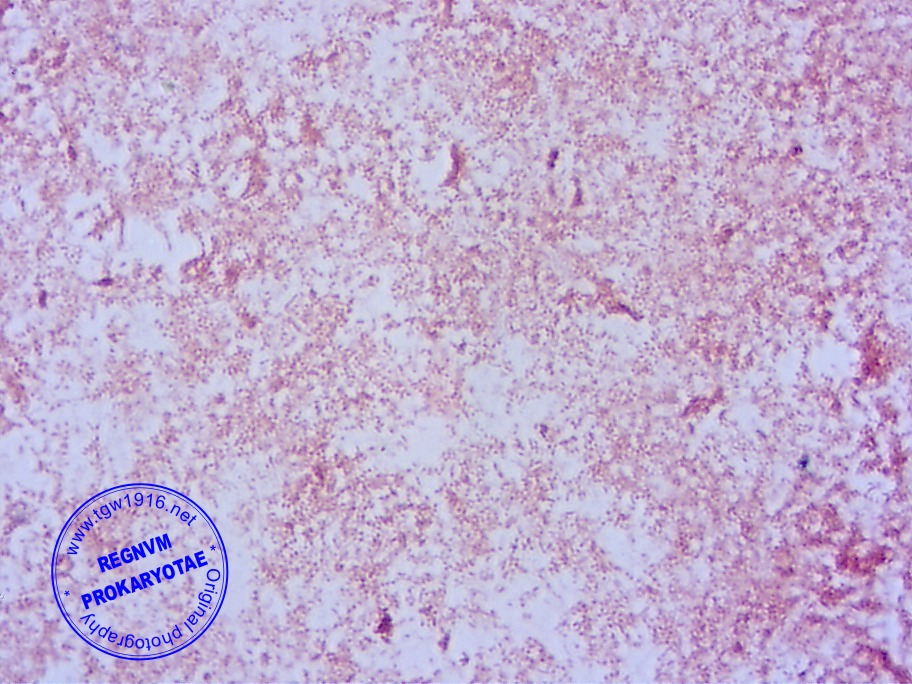
| M. haemolytica Gram-stained cells |
Taxonomy
Morphology
Cultural characteristics
Biochemical characters
Ecology
Pathogenicity
References
Phylum Pseudomonadota (Proteobacteria), Class Gammaproteobacteria, Order Pasteurellales, Family Pasteurellaceae, Genus
Mannheimia, Mannheimia haemolytica Angen, Mutters, Caugant, Olsen and Bisgaard 1999.
Corresponds to P. haemolytica biogrup 1 (Bisgaard and Mutters, 1986).
Historical synonym: Pasteurella haemolytica Newsom and Cross, 1932.
Mannheimia, Mannheimia haemolytica Angen, Mutters, Caugant, Olsen and Bisgaard 1999.
Corresponds to P. haemolytica biogrup 1 (Bisgaard and Mutters, 1986).
Historical synonym: Pasteurella haemolytica Newsom and Cross, 1932.
Gram-negative, small rods and coccobacilli. Non-motile.
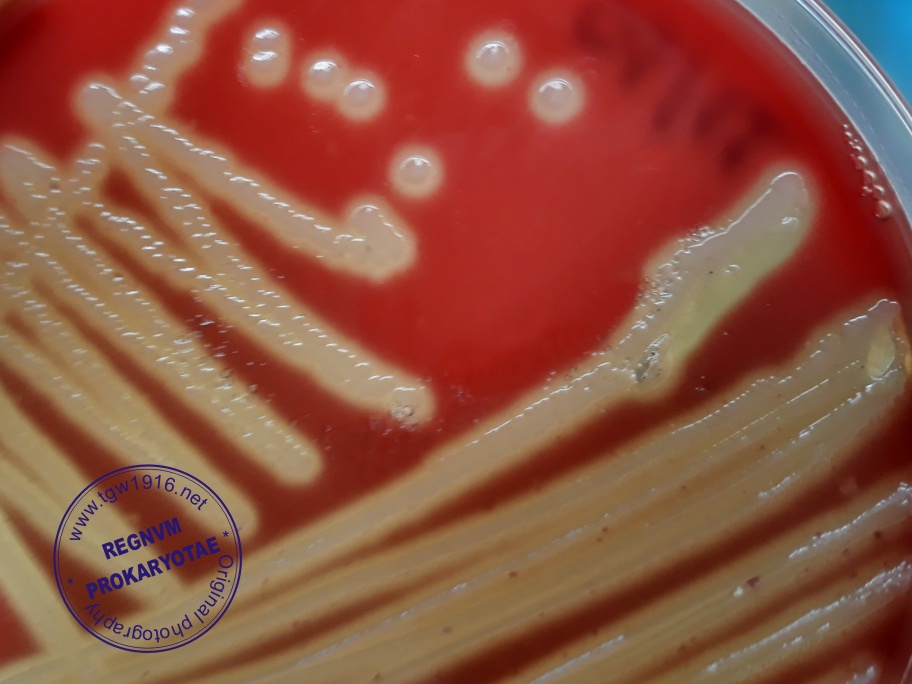
Colonies are regular, smooth, and graysh on blood agar; 1-2 mm in diameter
Most strains show a characteristic beta-hemolysis on bovine blood agar. Strains are
V-factor independent and X-factor independent. Growth on MacConkey is variable.
Growth is mesophilic and facultative anaerobic.
Most strains show a characteristic beta-hemolysis on bovine blood agar. Strains are
V-factor independent and X-factor independent. Growth on MacConkey is variable.
Growth is mesophilic and facultative anaerobic.
Present in nasopharynx and tonsils (almonds) of sheep and goat, and in the intestine
of chicken and turkey.
of chicken and turkey.
Pneumonia in cattle and sheep, mastitis in sheep, septicaemia in lambs. Rarely
human infections after animal contact.
Septicaemia in chickens (isolated from heart, bone marrow, liver and spleen of dead
chickens -admin note)
Potential virulence factors are the polysaccharide capsule, LPS, neuraminidase,
transferring binding proteins, sialoglycoprotease, leucotoxin.
human infections after animal contact.
Septicaemia in chickens (isolated from heart, bone marrow, liver and spleen of dead
chickens -admin note)
Potential virulence factors are the polysaccharide capsule, LPS, neuraminidase,
transferring binding proteins, sialoglycoprotease, leucotoxin.
- Mutters R., Angen Ø., Bisgaard M. 2004. Genus V. Mannheimia. In: Bergey’s Manual of Systematic Bacteriology, Second edition,
Vol two, part B, George M. Garrity (Editor-in-Chief), pp. 907-911. - W.M. Janda, R. Mutters, 2006. Pasteurella, Mannheimia, Actinobacillus, Eikenella, Kingella, Capnocytophaga, and other
miscellaneous Gram-negative rods. In: Topley & Wilson’s Microbiology and Microbial Infections, 10 edition, Vol. 2, Bacteriology,
Edward Arnold Ltd. - J. G. Holt et al., 1994. Facultatively Anaerobic Gram-Negative Rods. Subgroup 3. Family Pasteurellaceae. In: Begey’s Manual of
Determinative Bacteriology, 9th-edition, Williams & Wilkins, pp 194-196. - Carmen Pinzaru, 2009. Identificarea genurilor Pasteurella, Mannheimia, Actinobacillus.In:D.Buiuc, M.Negut (Ed.),Tratat de
Microbiologie Clinica, Ed. Medicala, Bucuresti, 859-868. - Buchanan R.E., Gibbons N.E. (co-editors), 1975. Bergey’s Manual of Determinative Bacteriology, eight edition, The Williams &
Wilkins Company, Baltimore.
| Mannheimia (Pasteurella) haemolytica colonies on Sheep Blood Agar |
Positive results for nitrates reduction, oxidase, alkaline phosphatase, catalase,
beta-glucosidase ONPG, acid production from: mannitol, D(-) sorbitol, D(-) fructose,
L(-) fucose, D(+) galactose, D(+) glucose (without gas), lactose, maltose, sucrose
(saccharose), raffinose and dextrin.
Negative results for alpha-glucosidase, gelatinase, H2S production (TSI), indole
production, Voges-Proskauer test, urease, arginine dehydrolase, lysine
decarboxylase, ornithine decarboxylase, acid production from: xylitol, L(+) arabinose,
L(-) xylose, dulcitol, D(+) mannose, L(-) sorbose, L(+) rhamnose, cellobiose, D(+)
melibiose, trehalose, inulin, esculin and salicin.
Variable results for acid production from: glycerol, D(-)arabinose and meso-inositol.
beta-glucosidase ONPG, acid production from: mannitol, D(-) sorbitol, D(-) fructose,
L(-) fucose, D(+) galactose, D(+) glucose (without gas), lactose, maltose, sucrose
(saccharose), raffinose and dextrin.
Negative results for alpha-glucosidase, gelatinase, H2S production (TSI), indole
production, Voges-Proskauer test, urease, arginine dehydrolase, lysine
decarboxylase, ornithine decarboxylase, acid production from: xylitol, L(+) arabinose,
L(-) xylose, dulcitol, D(+) mannose, L(-) sorbose, L(+) rhamnose, cellobiose, D(+)
melibiose, trehalose, inulin, esculin and salicin.
Variable results for acid production from: glycerol, D(-)arabinose and meso-inositol.

(c) Costin Stoica


| Back |