
| Staphylococcus lentus |
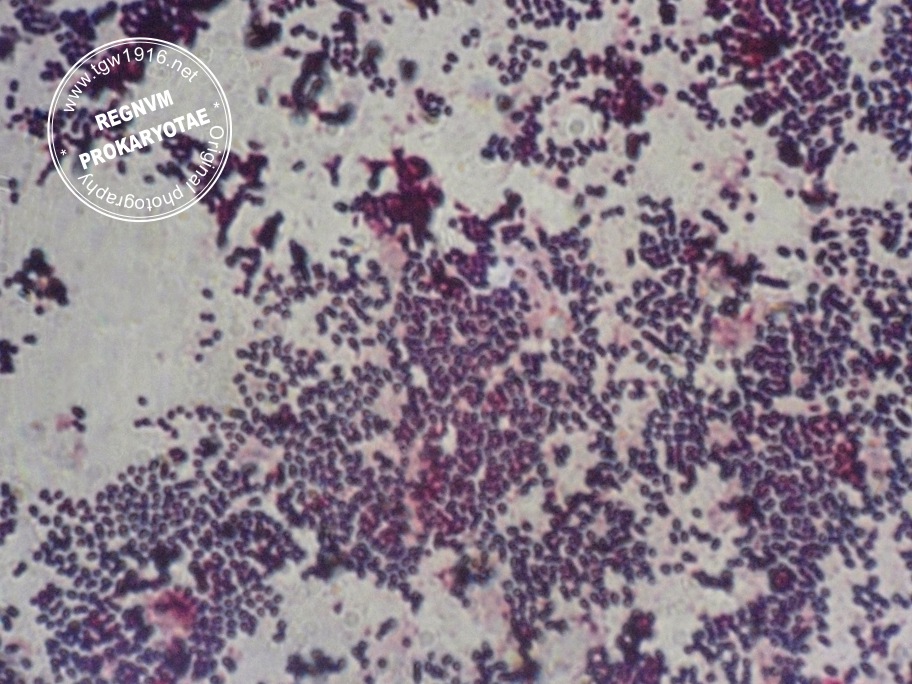
| Staphylococcus lentus, Gram-stain |
Taxonomy
Morphology
Cultural characteristics
Biochemical characters
Ecology
Pathogenicity
References
Phylum Bacillota (Firmicutes), Class Bacilli, Order Bacillales, Family Staphylococcaceae, Genus Staphylococcus, Staphylococcus
lentus Schleifer et al. 1983. Basonym: Staphylococcus sciuri subsp. lentus Kloos et al. 1976.
lentus Schleifer et al. 1983. Basonym: Staphylococcus sciuri subsp. lentus Kloos et al. 1976.
Gram-positive cocci, nonmotile, nonsporing, 0.7-1.2 μm in diameter; occuring singly,
in pairs or tetrads.
in pairs or tetrads.
Opaque, S-type, grayish white, white, or cream colonies. Some strains are mucoid.
Colony diameter 0.5-5 mm on P agar or 2-7 mm on tryptic soy agar. Optimum growth
temperature 25-35 ºC; no growth at 15 or 45 ºC. Facultative anaerobes; anaerobic
growth is weak and does not grow anaerobically in thioglycolate medium. Growth is
slow in 10% NaCl medium and growth poor in 15% NaCl.
Colony diameter 0.5-5 mm on P agar or 2-7 mm on tryptic soy agar. Optimum growth
temperature 25-35 ºC; no growth at 15 or 45 ºC. Facultative anaerobes; anaerobic
growth is weak and does not grow anaerobically in thioglycolate medium. Growth is
slow in 10% NaCl medium and growth poor in 15% NaCl.
Isolated from sheep, goat udder, raw milk , urine samples (human) also from
intestinal tract of house fly larvae (Musca domestica L.). Resistant to novobiocin.
intestinal tract of house fly larvae (Musca domestica L.). Resistant to novobiocin.
Associated with goat mastitis. Opportunistic pathogen in immunocompromised patients.
- Holt J.G., Krieg N.R., Sneath P.H.A., Staley J.T., Wiliams S.T., 1994. Bergey's Manual of Determinative Bacteriology, Ninth Edition,
Williams & Wilkins, Baltimore. Group 17, Gram-Positive Cocci, 527-558. - Schleifer K.H., Geyer U., Kilpper-Balz R. & Devriese L.A.: Elevation of Staphylococcus sciuri subsp. lentus (Kloos et al.) to species
status: Staphylococcus lentus (Kloos et al.) comb. nov. Syst. Appl. Microbiol., 1983, 4, 382-387. - Srdjan Stepanovic, Ivana Dakic, Donald Morrison, Tomasz Hauschild, Petr Jezek, Petr Petrás, An Martel, Dragana Vukovic,
Adebayo Shittu, and Luc A. Devriese: Identification and Characterization of Clinical Isolates of Members of the Staphylococcus
sciuri Group. Journal of Clinical Microbiology, February 2005, p. 956-958, Vol. 43, No. 2. - Karachalios, George; Michelis, Fotios; Kanakis, Konstantinos; Karachaliou, Iris; Koutri, Rozetta; Zacharof, Antonios: Splenic
abscess due to Staphylococcus lentus: A rare entity. Scandinavian Journal of Infectious Diseases, Volume 38, Number 8, August
2006 , pp. 708-710(3). - L. Zurek, C. Schal & D. W. Watson: Diversity & Contribution of the Intestinal Bacterial Community to the Development of Musca
domestica (Diptera: Muscidae) Larvae. J. Med. Entomol. 37(6): 924Ð928 (2000). - Karl-Heinz Schleifer and Julia A. Bell, 2009. Family VIII. Staphylococcaceae fam. nov.. In: (Eds.) P.D. Vos, G. Garrity, D. Jones, N.R.
Krieg, W. Ludwig, F.A. Rainey, K.-H. Schleifer, W.B. Whitman. Bergey’s Manual of Systematic Bacteriology, Volume 3: The
Firmicutes, Springer, 392-426.
Positive results for nitrate reduction, oxidase, deoxyribonuclease, benzidine test,
caseinase, catalase, esculin hydrolysis, gelatinase, beta-glucosidase, nuclease, acid
production from: trehalose, mannitol, raffinose, sucrose, cellobiose, ribose, mannose,
glucose, glycerol and fructose. Melibiose-positive on API 20 Staph kit (admin note).
Negative results for alkaline phosphatase, urease, coagulase-rabbit plasma, clumping
factor, beta-glucuronidase, beta-galactosidase, acetoin production, arginine
dihydrolase, acid production from: adonitol, D-arabitol, dulcitol, meso-erythritol,
D-erythrose, xylitol, xylose, melezitose, D-lyxose and turanose.
Variable results for staphylokinase production, acid production from: lactose,
arabinose, fucose, salicin, sorbitol and galactose.
caseinase, catalase, esculin hydrolysis, gelatinase, beta-glucosidase, nuclease, acid
production from: trehalose, mannitol, raffinose, sucrose, cellobiose, ribose, mannose,
glucose, glycerol and fructose. Melibiose-positive on API 20 Staph kit (admin note).
Negative results for alkaline phosphatase, urease, coagulase-rabbit plasma, clumping
factor, beta-glucuronidase, beta-galactosidase, acetoin production, arginine
dihydrolase, acid production from: adonitol, D-arabitol, dulcitol, meso-erythritol,
D-erythrose, xylitol, xylose, melezitose, D-lyxose and turanose.
Variable results for staphylokinase production, acid production from: lactose,
arabinose, fucose, salicin, sorbitol and galactose.

(c) Costin Stoica


| Back |