
| Streptococcus constellatus |
|
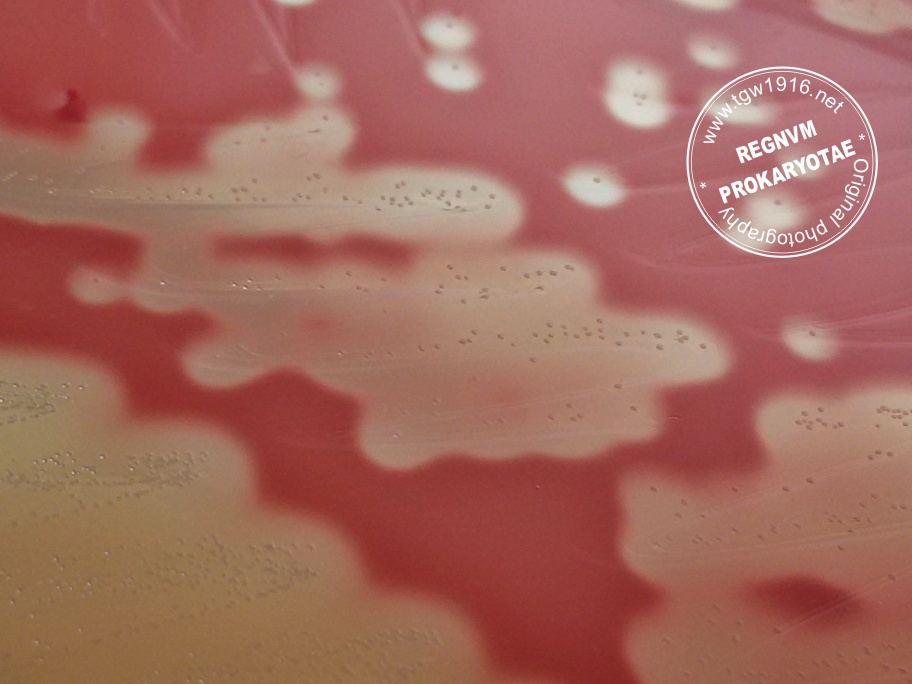
| Streptococcus constellatus subsp. constellatus colonies on Sheep Blood Agar |
Habitats are the oral cavity and upper respiratory tract in man.
Differential characters between S. anginosus and S. constellatus .
Taxonomy
Morphology
Cultural characteristics
Biochemical characters
Ecology
Pathogenicity
References
Phylum Bacillota (Firmicutes), Class Bacilli, Order Lactobacillales, Family Streptococcaceae, Genus Streptococcus, Streptococcus
constellatus (Prevot 1924) Holdeman and Moore 1974.
Three subspecies:
- Streptococcus constellatus subsp. constellatus (Prevot 1924) Whiley et al. 1999,
- Streptococcus constellatus subsp. pharyngis Whiley et al. 1999,
- Streptococcus constellatus subsp. viborgensis Jensen et al. 2013.
Historical synonyms: temporarily was included in Streptococcus anginosus species.
Strains are Lancefield group F, but may also belong to group A, C, or G.
Subsp. pharyngis and subsp. viborgensis belong to Lancefield group C.
constellatus (Prevot 1924) Holdeman and Moore 1974.
Three subspecies:
- Streptococcus constellatus subsp. constellatus (Prevot 1924) Whiley et al. 1999,
- Streptococcus constellatus subsp. pharyngis Whiley et al. 1999,
- Streptococcus constellatus subsp. viborgensis Jensen et al. 2013.
Historical synonyms: temporarily was included in Streptococcus anginosus species.
Strains are Lancefield group F, but may also belong to group A, C, or G.
Subsp. pharyngis and subsp. viborgensis belong to Lancefield group C.
Gram positive cocci, nonsporeforming, nonmotile, grouped in short chains.
Colonies on blood agar are 0.5-2.0 mm in diameter, white or translucent, convex, and
entire. Some strains produce colonies that are 0.5 to 1.0 mm in diameter, white, and
matte. Can grow at 45 ºC, but variable at 10 ºC. Grow better anaerobically. Growth is
reduced under aerobic conditions and is frequently enhanced by CO2. Some of the
strains require anaerobic conditions for growth. Most strains produce beta-hemolysis,
some may be alpha-hemolytic or nonhemolytic.
entire. Some strains produce colonies that are 0.5 to 1.0 mm in diameter, white, and
matte. Can grow at 45 ºC, but variable at 10 ºC. Grow better anaerobically. Growth is
reduced under aerobic conditions and is frequently enhanced by CO2. Some of the
strains require anaerobic conditions for growth. Most strains produce beta-hemolysis,
some may be alpha-hemolytic or nonhemolytic.
Subsp. constellatus strains were isolated from purulent infections in man. Subsp. pharyngis and subsp. viborgensis were isolated
from human throat infections (pharyngitis) with one strain from an abdominal mass.
from human throat infections (pharyngitis) with one strain from an abdominal mass.
- Anders Jensen, Tomonori Hoshino, and Mogens Kilian. Taxonomy of the Anginosus group of the genus Streptococcus and
description of Streptococcus anginosus subsp. whileyi subsp. nov. and Streptococcus constellatus subsp. viborgensis subsp. nov.
Int J Syst Evol Microbiol July 2013 63:2506-2519. - Robert A. Whiley and Jeremy M. Hardie, 2009. Genus I. Streptococcus Rosenbach 1884, 22AL. In: (Eds.) P.D. Vos, G. Garrity, D.
Jones, N.R. Krieg, W. Ludwig, F.A. Rainey, K.-H. Schleifer, W.B. Whitman. Bergey’s Manual of Systematic Bacteriology, Volume 3:
The Firmicutes, Springer, 655-711. - Coykendall A.L., Wesbecher P.M. & Gustafson K.B.: Streptococcus milleri, Streptococcus constellatus, and Streptococcus
intermedius are later synonyms of Streptococcus anginosus. Int. J. Syst. Bacteriol., 1987, 37, 222-228. - Whiley R.A. & Beighton D.: Emended descriptions and recognition of Streptococcus constellatus, Streptococcus intermedius, and
Streptococcus anginosus as distinct species. Int. J. Syst. Bacteriol., 1991, 41, 1-5.
Positive results for alkaline phosphatase, aginine hydrolysis, esculin hydrolysis,
leucine arylamidase, alpha-glucosidase (most strains), Voges-Proskauer reaction,
acid production from: glucose, N-acetylglucosamine, salicin (most strains) and
trehalose (most strains).
Negative for beta-galactosidase, beta-glucosidase, beta-fucosidase, pyrrolidonyl
arylamidase, beta-N-acetylgalactosaminidase, beta-N-acetylglucosaminidase,
alpha-galactosidase, beta-glucuronidase, alpha-L-fucosidase, sialidase (neuraminidase), acid production from: arabinose, glycerol,
inulin and sorbitol.
Variable results for: beta-D-galactosidase, beta-D-glucosidase, beta-D-fucosidase, acid production from: amygdalin, arbutin, cellobiose,
lactose, mannitol, melibiose and raffinose. Few strains produce hydrogenperoxide.
leucine arylamidase, alpha-glucosidase (most strains), Voges-Proskauer reaction,
acid production from: glucose, N-acetylglucosamine, salicin (most strains) and
trehalose (most strains).
Negative for beta-galactosidase, beta-glucosidase, beta-fucosidase, pyrrolidonyl
arylamidase, beta-N-acetylgalactosaminidase, beta-N-acetylglucosaminidase,
alpha-galactosidase, beta-glucuronidase, alpha-L-fucosidase, sialidase (neuraminidase), acid production from: arabinose, glycerol,
inulin and sorbitol.
Variable results for: beta-D-galactosidase, beta-D-glucosidase, beta-D-fucosidase, acid production from: amygdalin, arbutin, cellobiose,
lactose, mannitol, melibiose and raffinose. Few strains produce hydrogenperoxide.

(c) Costin Stoica


| Back |