
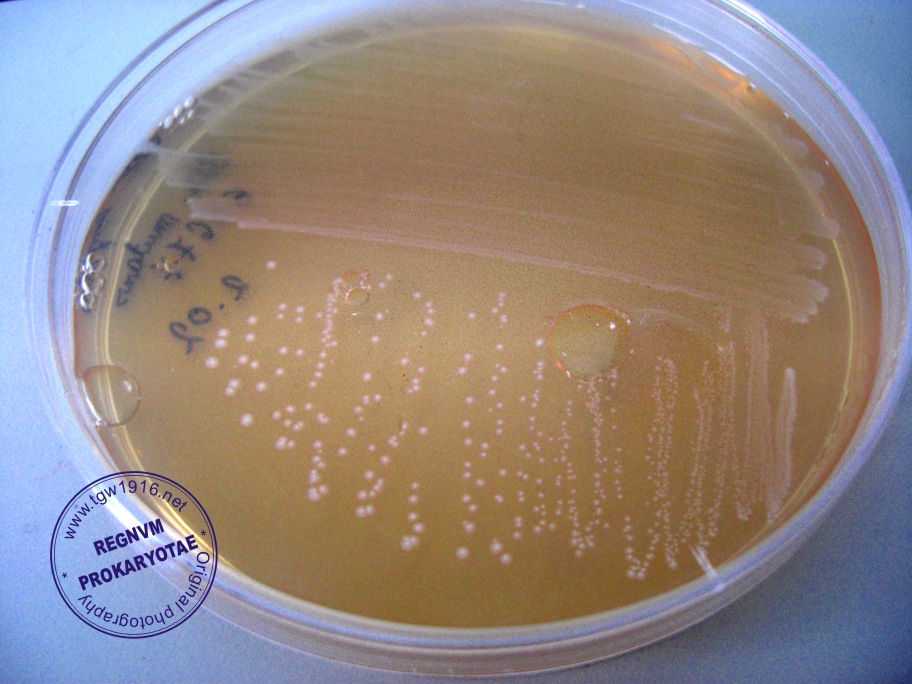
| Streptococcus mutans |
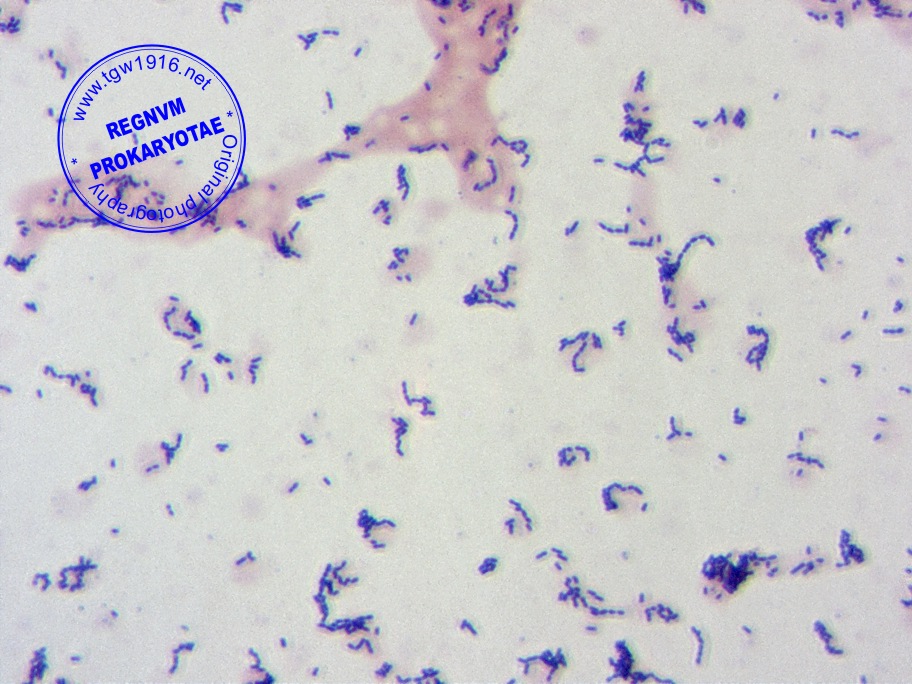
| Streptococcus mutans, Gram staining |
Taxonomy
Morphology
Cultural characteristics
Biochemical characters
Ecology
Pathogenicity
References
Phylum Bacillota (Firmicutes), Class Bacilli, Order Lactobacillales, Family Streptococcaceae, Genus Streptococcus, Streptococcus
mutans Clarke 1924.
Non-groupable by Lancefield antisera. Member of the "Mutans group".
mutans Clarke 1924.
Non-groupable by Lancefield antisera. Member of the "Mutans group".
Gram-positive cocci, 0.5-0.75 µm in diameter, grouped in medium-long chains,
nonmotile. On primary isolation from oral specimens, or in acid conditions in broth
and on some solid media, may form short rods (1.5-3.0 μm in length).
nonmotile. On primary isolation from oral specimens, or in acid conditions in broth
and on some solid media, may form short rods (1.5-3.0 μm in length).
Colonies are small, greywhite; become rough, heaped after 3-4 days; 1 mm diameter;
hard to pick; “run along in front of needle”. Usually alpha-hemolytic or non-hemolytic,
rarely beta-hemolytic. Some strains may form smooth or mucoid colonies.
Facultatively anaerobic, better growing under anaerobic condition or CO2-enhanced
atmosphere. Optimal growth temperature is 37.0 ºC. Growth at 45 ºC is variable. No
growth at 10 ºC. Grow on : Trypticase soy agar with defibrinated sheep blood.
hard to pick; “run along in front of needle”. Usually alpha-hemolytic or non-hemolytic,
rarely beta-hemolytic. Some strains may form smooth or mucoid colonies.
Facultatively anaerobic, better growing under anaerobic condition or CO2-enhanced
atmosphere. Optimal growth temperature is 37.0 ºC. Growth at 45 ºC is variable. No
growth at 10 ºC. Grow on : Trypticase soy agar with defibrinated sheep blood.
Human oral cavity inhabitant. Was first isolated from a carious lesion.
Strains have been isolated from feces.
Grow with 0.25% optocin. Resistant to bacitracin (most strains).
Strains have been isolated from feces.
Grow with 0.25% optocin. Resistant to bacitracin (most strains).
Involved in tooth decay and dental plaque forming. Sucrose is utilized to produce a sticky, extracellular, dextran-based polysaccharide
that allows them to cohere to each other forming plaque. When associated with S. sobrinus, dental caries may have a higher
incidence, especially in children. May cause endocarditis.
that allows them to cohere to each other forming plaque. When associated with S. sobrinus, dental caries may have a higher
incidence, especially in children. May cause endocarditis.
- Holt J.G., Krieg N.R., Sneath P.H.A., Staley J.T. and Williams S.T., 1994. Bergey's Manual of Determinative Bacteriology, Ninth
Edition, Williams & Wilkins, A Waverly Company, Baltimore, pp 527-558. - MITSUGI OKADA, YOSHIKO SODA, FUMIKO HAYASHI, TAKAKO DOI, JUNJI SUZUKI, KAZUO MIURA & KATSUYUKI KOZAI: PCR
detection of Streptococcus mutans and S. sobrinus in dental plaque samples from Japanese pre-school children. J. Med. Microbiol.
- Vol. 51 (2002), 443-447. - Coykendall AL. Proposal to elevate the subspecies of Streptococcus mutans to species status, based on their molecular
composition. Int. J. Syst. Bacteriol. 27: 26-30, 1977. - Richard Facklam: What Happened to the Streptococci: Overview of Taxonomic and Nomenclature Changes. Clinical Microbiology
Reviews, October 2002, p. 613-630, Vol. 15, No. 4. - Robert A. Whiley and Jeremy M. Hardie, 2009. Genus I. Streptococcus Rosenbach 1884, 22AL. In: (Eds.) P.D. Vos, G. Garrity, D.
Jones, N.R. Krieg, W. Ludwig, F.A. Rainey, K.-H. Schleifer, W.B. Whitman. Bergey’s Manual of Systematic Bacteriology, Volume 3:
The Firmicutes, Springer, 655-711.
Positive results for hydrolysis of esculin, leucine aminopeptidase, valine
aminopeptidase, chymotrypsin, phosphoamidase, alpha- or beta-glucosidase,
alpha-galactosidase, alpha-lactosidase, starch hydrolysis (most strains),
Voges-Proskauer reaction, acid production from: arbutin, D-cellobiose, esculin,
galactose, glucose, inulin, lactose, maltose, mannitol, mannose,
N-acetylglucosamine, raffinose, salicin, sorbitol, sucrose and trehalose.
Negative results for alkaline phosphatase, hippurate hydrolysis, urea hydrolysis,
beta-glucosaminidase, glycyltryptophan arylamidase,
N-acetyl-beta-D-galactosaminidase, N-acetyl-beta-D-glucosaminidase,
beta-D-glucuronidase, alpha-fucosidase, beta-D-fucosidase, beta-mannosidase,
beta-maltosidase, alpha-arabinosidase, pyrrolidonyl arylamidase, hyaluronidase,
neuraminidase (sialidase), acid production from: adonitol, arabinose, cyclodextrin,
dulcitol,erythritol, glycerol, glycogen, gluconate, inositol, methyl D-glucoside, methyl
D-mannoside, methyl D-xyloside, melezitose, rhamnose, ribose, sorbose, starch and
xylose.
Variable results for alpha-galactosidase, acid production from amygdalin & melibiose.
aminopeptidase, chymotrypsin, phosphoamidase, alpha- or beta-glucosidase,
alpha-galactosidase, alpha-lactosidase, starch hydrolysis (most strains),
Voges-Proskauer reaction, acid production from: arbutin, D-cellobiose, esculin,
galactose, glucose, inulin, lactose, maltose, mannitol, mannose,
N-acetylglucosamine, raffinose, salicin, sorbitol, sucrose and trehalose.
Negative results for alkaline phosphatase, hippurate hydrolysis, urea hydrolysis,
beta-glucosaminidase, glycyltryptophan arylamidase,
N-acetyl-beta-D-galactosaminidase, N-acetyl-beta-D-glucosaminidase,
beta-D-glucuronidase, alpha-fucosidase, beta-D-fucosidase, beta-mannosidase,
beta-maltosidase, alpha-arabinosidase, pyrrolidonyl arylamidase, hyaluronidase,
neuraminidase (sialidase), acid production from: adonitol, arabinose, cyclodextrin,
dulcitol,erythritol, glycerol, glycogen, gluconate, inositol, methyl D-glucoside, methyl
D-mannoside, methyl D-xyloside, melezitose, rhamnose, ribose, sorbose, starch and
xylose.
Variable results for alpha-galactosidase, acid production from amygdalin & melibiose.

(c) Costin Stoica

| Streptococcus mutans colonies on BHI Agar |

| Back |